Columbus Police Shooting: Officer Pleads Guilty After Donovan Lewis Was Shot While Lying in Bed
Scroll to the bottom to view the full Parts 1, 2, and 3

Columbus Police Shooting: Officer Pleads Guilty After Donovan Lewis Was Shot While Lying in Bed
A 2022 Police Raid Has Returned to the National Spotlight
Four years after a late-night police operation in Columbus, Ohio, a former police officer has finally entered a guilty plea in a case that has remained deeply controversial.

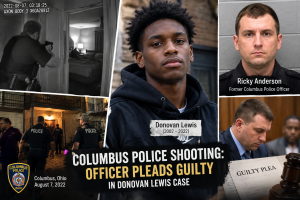
Former Columbus police officer Ricky Anderson pleaded guilty to reckless homicide in September 2026 in connection with the fatal shooting of 20-year-old Donovan Lewis.
The case has attracted national attention because of what police body-camera footage appeared to show: officers arrived at Lewis’ apartment in the early hours of the morning to execute arrest warrants, Anderson opened a bedroom door, and Lewis was fatally shot almost immediately.
Lewis was lying in bed.
The former officer was facing a murder charge, but prosecutors agreed to drop that charge as part of a plea agreement. Anderson entered what is known as an Alford plea, meaning he accepted that prosecutors had enough evidence to support a conviction while not formally admitting guilt.
For Lewis’ family, however, the agreement does not end the controversy.
Their attorney argued that no criminal sentence can undo the loss of a young man whose life ended during what was supposed to be an arrest operation.
The case now raises one of the most difficult questions in American policing:
When police officers enter a home to arrest someone, how quickly can a situation become deadly—and what responsibility does an officer have before pulling the trigger?
The Night Police Came Looking for Donovan Lewis
The incident happened in August 2022.
Columbus police officers went to an apartment in the middle of the night to execute arrest warrants.
According to police accounts, Lewis was wanted on multiple warrants, including allegations involving domestic violence, assault and felony improper handling of a firearm.
Police were therefore not responding to a simple traffic violation or minor disturbance.
They were attempting to locate and arrest a person they believed was wanted on serious charges.
That distinction is important.
Police officers executing an arrest warrant are entering a situation that can potentially become dangerous.
They may not know whether the person inside is armed.
They may not know who else is inside the home.
They may not know whether someone will attempt to escape or attack them.
That uncertainty is one of the central arguments made by officers involved in high-risk arrests.
But the Lewis case became controversial because of what happened immediately after officers reached the bedroom.
According to reporting by The Associated Press, Anderson’s body-camera footage appeared to show him firing within approximately a second of opening the bedroom door.
Lewis was lying in bed.
He was killed during the operation.
Why the Bodycam Footage Became So Important
Body-camera footage has transformed the debate over police shootings in the United States.
Before widespread body cameras, the public often had to rely on competing accounts.
Police departments would release statements.
Witnesses would provide their recollections.
Family members would describe what they had been told.
Attorneys would make arguments.
But there might be no independent visual record.
The Lewis case was different.
The officers were wearing body cameras.
That meant investigators and the public could examine the sequence of events from the officers’ perspective.
According to the Associated Press, the footage appeared to show Anderson firing almost immediately after opening the bedroom door.
That detail became one of the most controversial aspects of the case.
To critics, the question was obvious:
Was there enough time to determine whether Lewis posed an immediate threat?
Police and Anderson’s defense offered a different perspective.
Anderson’s attorneys argued that evidence presented at trial would have supported the officer’s use of deadly force.
That disagreement illustrates why police shooting cases can become so complicated.
The public sees a fraction of a second.
The officer sees an uncertain situation.
Investigators later reconstruct the event frame by frame.
And prosecutors must decide whether the evidence is sufficient to establish criminal liability beyond a reasonable doubt.

The Difference Between an Arrest and a Deadly Encounter
The purpose of the operation was to arrest Lewis.
But the situation ended as a fatal shooting.
That transition is at the heart of the controversy.
Police officers are legally permitted to use force in certain circumstances.
Deadly force is generally subject to a much higher standard because it can permanently end a person’s life.
The central question in cases like this is not simply whether the person being arrested had outstanding warrants.
It is whether the officer reasonably believed deadly force was necessary at the moment the shot was fired.
That distinction matters.
A person can be wanted by police and still not pose an immediate threat.
Conversely, someone who is wanted can also potentially present a serious danger.
The existence of an arrest warrant does not automatically determine whether deadly force is justified.
That is why the exact sequence of events becomes so important.
Did Lewis move?
Did he reach toward something?
Was there a weapon?
Could officers see his hands?
What did Anderson know at the moment he fired?
What did the officer reasonably believe was happening?
Those questions became central to the legal battle.
Anderson Was Not Immediately Convicted of Murder
One of the most important developments came years after the shooting.
Anderson eventually faced a murder charge.
But in September 2026, prosecutors and the defense reached a plea agreement.
Anderson pleaded guilty to reckless homicide, a lesser offense.
The murder charge was dropped as part of the agreement.
The former officer entered an Alford plea.
An Alford plea is unusual because the defendant does not necessarily admit the factual allegations in the same way as a traditional guilty plea.
Instead, the defendant acknowledges that prosecutors possess enough evidence that could support a conviction.
That distinction matters in Anderson’s case.
The plea represents a major legal development.
But it also leaves some people dissatisfied.
Lewis’ family has continued to argue that the case deserves a stronger form of accountability.
The family’s attorney said the plea could not bring Donovan back and questioned whether the outcome truly represented justice.
Why the Family Says the Case Is Not Over
For a police officer, a criminal case can eventually reach a legal conclusion.
For a family, the consequences can last for decades.
Donovan Lewis was 20 years old.
His family lost him during a police operation that was supposed to result in an arrest.
No sentence can reverse that.
No settlement can restore his life.
No body-camera review can change what happened inside that bedroom.
That is why the Lewis family’s response to Anderson’s plea has been so strong.
The family has also pursued a civil lawsuit against the former officer.
A civil case is different from a criminal prosecution.
A criminal case determines whether the defendant should face punishment under criminal law.
A civil lawsuit can seek financial damages and address alleged violations of a person’s rights.
The two proceedings can therefore produce very different outcomes.
Supporters of Police Point to the Danger of Warrant Operations
There is another side to the story that cannot be ignored.
Police officers who execute arrest warrants do not know exactly what they will encounter when they arrive.
A warrant involving allegations of violence or weapons can present genuine danger.
Officers must make decisions quickly.
A person inside a dark bedroom may suddenly move.
A hand may disappear from view.
An object may be mistaken for a weapon.
An officer may believe that another person is about to attack.
These circumstances are precisely why police departments train officers to respond quickly.
Anderson’s defense has argued that the evidence would have supported his decision to use deadly force.
That argument reflects a broader concern within law enforcement:
Officers should not have to wait until a suspect fires a weapon before protecting themselves.
Critics respond that there is an equally important principle:
Police should not assume that every movement made by a suspect inside a home represents an imminent deadly threat.
The balance between those two principles is one of the hardest problems in modern policing.
The Question of What Anderson Could See
The physical layout of the room is extremely important.
When officers open a bedroom door in a dark apartment, visibility can be limited.
An officer may see only a silhouette.
A person may suddenly move.
The officer’s perception can change in a fraction of a second.
This is one reason prosecutors and defense attorneys often spend enormous amounts of time reconstructing police shootings.
They examine body-camera footage.
Lighting.
Door positions.
Angles.
Distances.
Audio.
Commands.
Movements.
Weapons.
The timing between an officer seeing a suspect and firing a weapon.
In a normal human conversation, one second feels like almost nothing.
In a police shooting, one second can contain an entire chain of decisions.
That is why the video became so significant in the Lewis case.
The Broader History of Columbus Police Controversies
The Lewis shooting did not happen in isolation.
Columbus police had already faced intense national scrutiny over use of force involving Black residents.
The U.S. Justice Department agreed in 2021 to review Columbus Police Department practices following several fatal police shootings involving Black people and the city’s response to racial injustice protests in 2020.
One of the shootings specifically mentioned in discussions surrounding the federal review was the 2021 killing of 16-year-old Ma’Khia Bryant.
The broader context matters because public trust does not exist separately from previous events.
When another fatal shooting occurs, residents do not necessarily view it as a completely isolated incident.
They compare it with what happened before.
They ask whether police training has changed.
They ask whether disciplinary systems work.
They ask whether officers are held accountable.
And they ask whether officials are telling the public the complete story.
Why This Case Has Become a Debate About Police Training
One of the biggest questions is whether officers should receive additional training for situations involving sleeping or apparently unaware suspects.
Police training generally emphasizes threat recognition and rapid decision-making.
But the Lewis shooting raises another issue:
How should officers distinguish between a person waking up and a person preparing to attack?
That distinction may be incredibly difficult.
A sleeping person can suddenly sit up.
A person may instinctively raise an arm.
A person may reach toward a bedside table.
None of those actions automatically means that the person intends to attack an officer.
At the same time, officers cannot know someone’s intentions with certainty.
That uncertainty creates a dangerous environment for everyone involved.
The person inside the home faces the possibility of being perceived as a threat.
The officer faces the possibility of being attacked.
And a split-second misunderstanding can become irreversible.
The Problem With Judging a Split Second Years Later
There is a philosophical problem at the center of almost every police shooting case.
How should we judge a decision made in one second using information gathered over several years?
Investigators can review the footage repeatedly.
Lawyers can slow it down.
Experts can analyze every movement.
Jurors can watch the same moment again and again.
But Anderson did not have that luxury.
He had only the information available at the moment the bedroom door opened.
That is one reason police-defense attorneys often argue that officers should be judged based on what they reasonably perceived at the time rather than what investigators later discover.
Critics respond that this standard can become too forgiving.
If officers can claim that they feared a threat whenever a suspect moves, accountability becomes difficult.
The legal system therefore has to balance both realities.
Officers need protection when they make reasonable decisions under genuine threat.
Civilians need protection when officers use unreasonable or reckless force.
Why the Alford Plea Is Generating Debate
The Alford plea adds another layer of controversy.
Anderson did not simply stand in court and say that every allegation against him was true.
Instead, he accepted that prosecutors had enough evidence to support a conviction while maintaining the legal posture associated with an Alford plea.
For some observers, the distinction is frustrating.
They want a clear admission.
They want the officer to say exactly what happened and accept responsibility.
For others, the plea represents a practical compromise.
The prosecution secured a felony conviction without having to proceed through a potentially lengthy and uncertain murder trial.
The defense avoided the risk of a murder conviction.
Anderson will still face sentencing for reckless homicide.
According to AP reporting, the possible sentence could range from probation to three years in prison.
Is Reckless Homicide Enough?
That question will likely remain at the center of the debate.
For Anderson’s supporters, the plea represents a serious criminal consequence for a tragic incident.
For Lewis’ family and many police-reform advocates, however, the reduction from murder to reckless homicide may feel insufficient.
The disagreement reflects different interpretations of the same event.
Was the shooting an intentional killing?
Was it a tragic mistake?
Was it a reckless act?
Was Anderson responding reasonably to a perceived threat?
Or did he act too quickly?
The legal system ultimately reached a plea agreement rather than allowing a jury to resolve those questions through a murder trial.
That means the public may continue debating the case for years.
Bodycam Videos Are Changing the Police Accountability Debate
The Lewis case also demonstrates why body cameras have become such a powerful tool.
A bodycam can protect civilians.
But it can also protect officers.
That distinction is important.
When footage contradicts an officer’s report, investigators have another source of evidence.
When footage confirms an officer’s account, it can prevent false accusations.
The technology is therefore not inherently pro-police or anti-police.
It is evidence.
The challenge is ensuring that departments release and preserve footage appropriately and that investigators examine the complete recording rather than isolated clips.
A 10-second clip can create outrage.
A complete video can create understanding.
Sometimes it creates even more questions.
The Lewis case is an example of the third category.
The Viral Nature of Police Shootings
Social media has also changed the way Americans experience controversial police cases.
A police shooting can become national news within hours.
A clip can be reposted thousands of times.
Commentators can form opinions before investigators release their findings.
Hashtags can turn an individual case into a political movement.
This can be valuable.
Public pressure can force officials to investigate cases that might otherwise receive little attention.
But there is also a downside.
Short videos often remove context.
A viewer may see the final second without seeing what happened beforehand.
Another viewer may see an edited version.
A third may watch commentary rather than the original footage.
The result can be millions of people debating an event they have not independently investigated.
The Lewis case demonstrates why viewers should be cautious.
The shooting was unquestionably real.
But the legal question of whether Anderson committed murder, manslaughter or reckless homicide required far more than a viral clip.
A Young Man’s Life Reduced to a Few Seconds of Video
Perhaps the saddest aspect of cases like this is how quickly a person’s identity can disappear.
Online, Donovan Lewis can become a name associated with a police shooting.
But he was more than the final moments of his life.
He was 20 years old.
He had a family.
Friends.
Relationships.
Plans.
The public often sees police bodycam footage as evidence.
For families, it can represent the final recorded moments of someone they loved.
That creates a difficult ethical question about how such footage should be distributed.
Transparency matters.
But so does human dignity.
News organizations have to balance the public interest with the reality that graphic footage can be replayed endlessly online.
What the Case Means for Police Officers
The case also sends a message to law enforcement officers.
Every decision made during a high-risk arrest may eventually be examined.
An officer may believe that a suspect is reaching for a weapon.
Years later, attorneys may examine that movement frame by frame.
A department may review the officer’s training.
A prosecutor may review the evidence.
A jury may ultimately determine criminal responsibility.
That does not mean officers should hesitate when facing a genuine deadly threat.
But it does mean officers must understand the enormous consequences of using deadly force.
One decision can end a person’s life.
It can end an officer’s career.
It can create a criminal prosecution.
And it can permanently affect an entire family.
What Happens Next for Ricky Anderson?
Anderson’s criminal case has now reached the sentencing stage.
His guilty plea means the case will not proceed to a murder trial.
But the legal consequences are not necessarily finished.
He still faces sentencing for reckless homicide.
The Lewis family’s civil lawsuit also remains an important part of the broader legal picture.
And the controversy surrounding the shooting will likely continue to influence discussions about Columbus police training and use-of-force policies.
The case has already become part of a larger national conversation about how officers execute warrants and how quickly an arrest operation can become a deadly encounter.
The Question Americans Are Still Asking
Four years after Donovan Lewis was killed, the most important question remains remarkably simple:
Could this shooting have been prevented?
That question does not necessarily accuse every officer involved of misconduct.
It asks whether different tactics, better communication, different positioning, improved training or greater restraint could have produced a different outcome.
If the answer is yes, the case becomes more than a criminal prosecution.
It becomes a lesson.
A lesson about warrant operations.
A lesson about identifying threats.
A lesson about the use of deadly force.
And a lesson about the consequences of decisions made in fractions of a second.
Final Takeaway
The Donovan Lewis case is one of the most controversial police shooting cases to return to the spotlight in 2026.
The reason is not simply that a former police officer has pleaded guilty.
It is because the underlying facts remain deeply disturbing and difficult to reconcile.
Police went to an apartment to arrest a wanted man.
A bedroom door opened.
A shot was fired.
A 20-year-old man was dead.
Four years later, the former officer responsible for the shooting has pleaded guilty to reckless homicide under an Alford plea, while the murder charge was dropped as part of the agreement.
For prosecutors, the plea represents a criminal conviction.
For the defense, it avoids a murder conviction.
For Lewis’ family, however, the central fact remains unchanged.
Donovan Lewis is gone.
And the questions surrounding the final seconds of his life will likely continue to shape America’s debate over police warrants, body cameras, use of force and accountability.
The case also offers a broader warning.
A police warrant may authorize officers to enter a home—but it does not erase the need for judgment.
Every movement matters.
Every decision matters.
And when a decision involves a firearm, one second can change everything.
That is why the Donovan Lewis case remains so controversial.
It is not only about what happened in one Columbus bedroom in 2022.
It is about how American policing handles uncertainty when officers enter someone’s home—and what happens when the person on the other side of the door never gets another chance to explain what happened.